

Musa (2001) Review aka Musa the Warrior

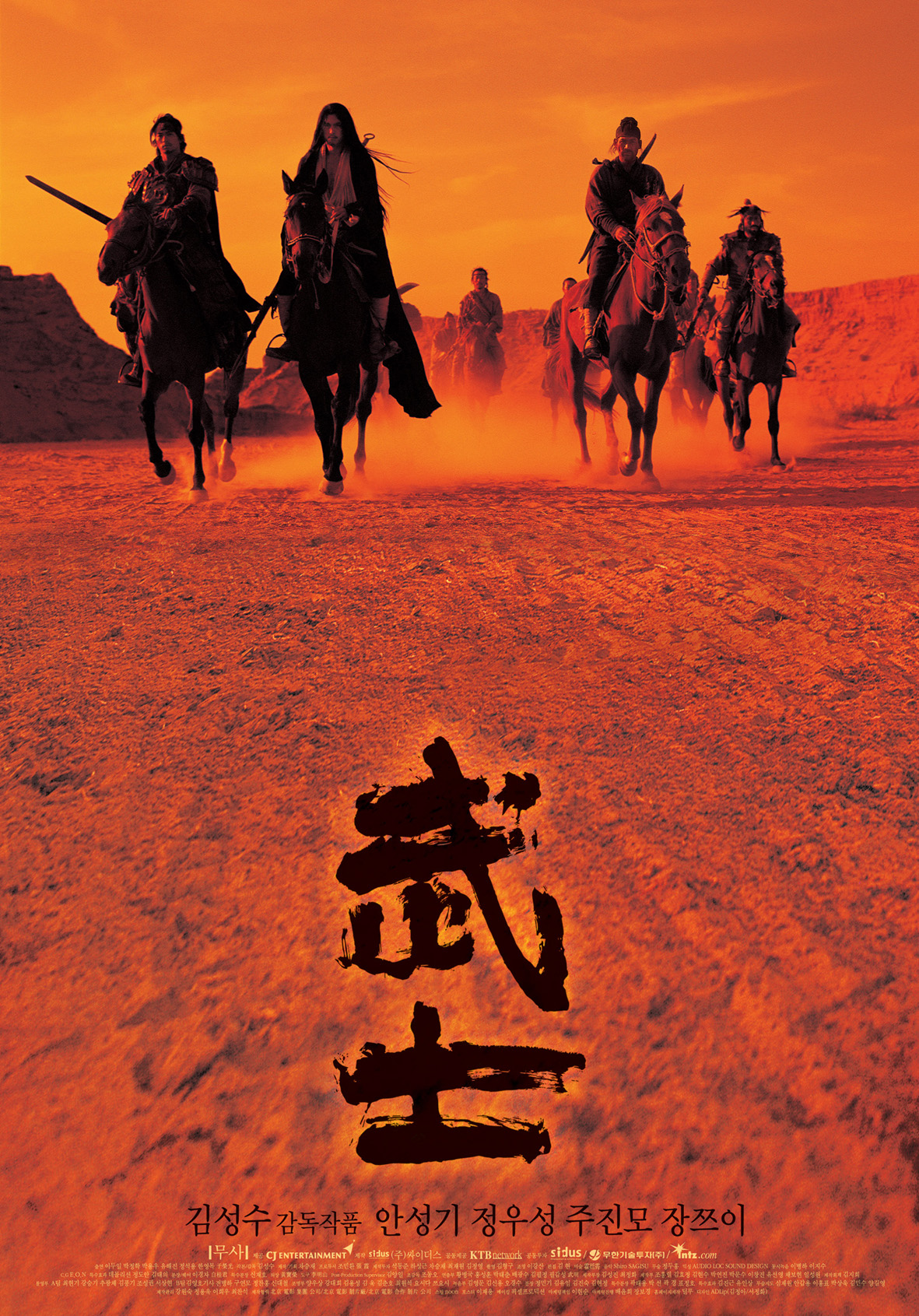
"Musa" Korean Theatrical Poster

"Musa" Korean Theatrical Poster

AKA: Warrior, The Warriors
Director: Kim Sung-su
Writer: Kim Sung-su
Producer: Cha Seoung-jae, Xia Shang
Cast: Ju Jin-mo, Jung Woo-sung, Ahn Sung-kee, Zhang Ziyi, Park Yong-woo, Park Jeong-hak, Yu Hye-jin, Jeung Seok-yong, Lee Du-il, Han Yeong-mok, Yu Rong Guang
Running Time: 158 min.

By JJ Hatfield

Musa is a sweeping cinematic saga of grand proportions set in 1375 A.D. It tells the story of a Korean diplomatic envoy that attempts to meet with the Chinese and address problems in a civilized and non – violent manner. In other words hoping to prevent a war.

The plot is based loosely in history. In negotiation attempts a Chinese Ambassador was killed as he was journeying to Korea. This lead to other incidents with China resulting in very tense relations. Some envoys were captured by the Ming and considered spies for Korea or the Mongol. Others faced jail, killed or were simply never heard from again. In a land of seemingly endless desert, the journey has just begun.

Considering the importance of negotiations Korea sends yet another diplomatic envoy to Nanjing. Since the Ming take – over Korea is even more anxious to establish allied relations. This time there will be a few soldiers accompanying the group for their safety. An honorable young general is chosen to lead the group along with the two diplomatic ambassadors, a mute servant Yee-sol (Woo-sung Jung) to the vice ambassador, an interpreter, a few Korean military and local militia.

They are led by General Choi Jung (Ju Jin-mo). He is young, intelligent an expert in battle but arrogant. He will do anything to make sure the mission is a success. Anything. His ever-loyal right hand man confidant, and self appointed personal guard Ga-nam (Jeong-Hak Park) always at his side, ready to go into action. It is also Ga-nam who unofficially becomes the connection between the general and the troops.

At last the envoy reaches Nanjing. They are all relieved to be at their destination and there is a small ceremonial escort for them. The group is told that the castle is in too poor a state for visitors with the recent fighting that had taken place and a special area has been prepared for negotiations. The General is suspicious but he dare not protest and risk offending anyone. Without warning the group is surrounded by archers from above and soldiers ringing them below! They start to fight but the ambassadors appeal for reason and calm. The small group is completely outnumbered and has no chance of fighting their way out of this trap. The situation is total chaos with the men pushing and shoving cursing yelling. The General refuses to surrender especially after they are told to give up all their weapons. To their utter dismay they are accused of being spies, or a military unit in disguise in Nanjing to commit some act of treachery or violence. The General in particular is greatly offended at the mere suggestion they are there on anything but an honorable mission. The Ming are not interested in wasting time listening to the ambassadors or anyone else. Eventually everyone reluctantly disarms including General Choi Jung.

The Royal Court sentences the envoy to be exiled as enemies of the Ming. Despite age or condition the envoy is tied together like a string of animals being led to slaughter. The prisoners are shown no mercy as they are driven deeper into the harsh desert. No shelter from the blinding sun blistering the skin, tongues swelling from dehydration, lips cracked open and the constant sand in their mouths and eyes. Just trying to keep moving through the shifting dunes was a tremendous difficulty. Life was being drained from them. The pace, the heat, the lack of water was taking a heavy toll on everyone.

Without warning arrows rain from the sky and a group of Mongol soldiers appear on the attack. There are men on horses, Ming soldiers fighting blades glaring in the mid day sun like flames of fire. The envoy members still strung together and helpless. It’s total frantic confusion and no one can tell what is happening! Men are yelling and screaming. Cries of the wounded and dying split the clamor. It’s impossible to see who their enemy really is in the midst of the swirling dust with brutal fighting surrounding them. The Mongol soldiers kill the Ming immediately. They leave the envoy from Korea to their own fate.

Though nothing that has happened is really the General’s fault he is beginning to see it as his failure and sometimes looks at the others, wondering if they ever think that too. The mission had been a disaster from the beginning before they even reached the castle in Nanjing. They had been betrayed by the Ming bastards and he seems to feel he somehow should have prevented it. Ga-nam is ever supportive but even he realizes that they have no hope of saving the mission and the trip back to Korea was far from certainty.

The Korean soldiers of course do not question the general’s orders but the local militia balk at some of the general’s decisions and dare say so. The tension rises. That particular encounter may end but the tension level does not decrease. Headed back to Korea the group is fading fast. The brutal conditions could only be survived for so long. Emotions are as raw as the blisters on their skin. Out of no where they find a true oasis, but they have no money or weapons to trade. Dying of thirst they can barely be held back. Just as blood is about to be spilt a Buddhist Monk, Ji-san (Du-il Lee) pays for the envoy.

Everyone is physically and emotionally exhausted, most injured and in desperate need of nourishment and rest. At last they have a break and can relax. For the first time even the General feels more confident in somehow at least returning to Korea. Suddenly a dust trail was swarming into the market. They couldn’t tell who it was nor could they ask the local people. Ready to fight they are overwhelmed by a great number of Mongol soldiers including the Mongol General. in yet another extremely tense encounter Ji-san intervenes and the situation is diffused temporarily.

It is actually here you see General Choi Jung begin to learn from what he discovers instead of always believing what he has been taught. With the various armies, enemies, cut throats and thieves no one sleeps soundly including Yee-sol. The rest of the envoy is exhausted as is General Choi Jung but he wants to find out more about something he heard earlier, something about a princess. He discovers she is a Ming Princess kid napped by the Mongol soldiers. The General considers the situation and decides the envoy will rescue her. He tells his men that if they save the Ming Princess and return her safely to Nanjing it will definitely assure a friendly relationship with Korea. It will more than accomplish the original mission. They will be welcomed as heroes.

From out of nowhere comes the Mongol soldiers with the Princess. It seems a reckless plan but they charge ahead and manage to free her and Yee-sol. After that everything changes between the general and Yee-sol. After that everything changes.

No doubt the viewer has heard Musa is full of vicious, savage, bloody violence. That fact is supposedly why this South Korean movie though released in 2001, has been legally hard to obtain and even then there were a few minutes cut before it was out of production. Of course Musa is violent, there are a number of people trying to survive and even more people trying to kill them! Does this film show more than most in a similar drama? Yes and no. There are films with a higher body count but none will put you inside the middle of the fighting like this one. A hand held effect adds greatly to the feeling and it is not over-used.

At times the screen is so full of fighting and bodies it’s difficult to tell who is who or where to run. It’s a chaotic, confusing collage with people fighting, hacking, screaming, blood spurting and totally dis-orienting on a mental and physical level. Hand to hand combat is it’s own kind of hell.

The primary characters are not typical for this kind of film. Not even Yee-sol nor the General are the same as when they first met. After the traumas and fighting there are slight cracks that begin to show through the characters. Yee-sol is selfless and brave but does not have much patience when he sees injustice. He will go to any length to save the princess, but by his own ways. The General is growing angry at losing the royal and military breakdown and Yee-sol’s behavior. Ga – dan wants to support his General but he has doubts. The civilian military just want to make it home.

Musa is a film you will want to watch more than once just to try and take in the enormous scope of the film. The action will keep you involved and your adrenaline soaring. The action and fighting alone is more than enough to raise this movie into the higher numbers!

The cinematography is most impressive. There may hay have been some cgi or even matte used but most of it is very much real. The attention to detail is quite remarkable. Not only are the landscape shots dazzling they provide a feeling of being there.

Not only should you watch Musa for the absolutely spectacular action but also for the the intense attention to detail put into the film. From huge outdoor battle scenes to tightly huddled civilians you never feel like any of this is false or fake. The costumes are quite detailed even for the regular villagers and for the militia army outfits. Yee-sol wears a cloak with some beautiful embroidery and the Mongol sweaters and hats are a work of art. (The Mongol General has the coolest beard ever!) As would happen in such a situation everyone wears what they have. (It is also easier to identify sometimes during battles.) The materials in general were appropriate for the time. In fact I could only find one version of a weapon I couldn’t validate was actually produced then, but who can really say? There was tremendous effort put into every single area of this film!

Another aspect of originality is that there are times that heroes can appear to be villains – and villains to be heroes. Thankfully there is more than the Mongol hordes. They were originally called “hordes” because of their nomadic lifestyle with yurt like compounds. They were from the area of Turkey and once exiled found it necessary to move around in order to survive once limited local resources were exhausted.

Obviously an ensemble effort there was a lot of sweat, love and blood put into Musa. The production is a big budget, huge cast with enormous talent that will stay with you a life time! Unlike too many movies that make similar claims this is the real deal. Written, Directed and Produced by Kim Seong Ki as fabulous as the action there is also a genuine plot and very distinct characters. It takes more than one viewing the action quality is so superb! It takes a bit to look deeper than the amazing action.

The film’s original score was composed by Shiro Sagisu. It is not perfect perhaps but definitely enhances the movie whether a tense quiet exchange or all out hell in battle or focusing on just the landscape.

This is one of the best films at representing real fighting I have ever seen. Amputations, arrows into necks, swords through the head, more than a few decapitations, and plenty of blood. There have been some complaints about it being too violent (whatever that really means). But there are no purposely sadistic scenes. Non of the violence is gratuitous. On the contrary it is what forces the characters to delve inward and discover they may not like what they learn.

I cannot review this film without mentioning the fabulous horses and the team working with them! Though I’m quite familiar with stunt horses it always amazes me to see them live or in film doing crazy shit like the stunt guys. And like the stunt guys they just blow it off and go have a smoke,lol. I think people worry more about injuries of the horses than the stunt men/women! However safety is of great concern to me and animals are usually treated very well. Those horses are fantastic! And in the desert yet!

After you have watched Musa several times really start paying attention to the story line. There may not be much exposition but looks and subtle acts say a great deal. Aside from the obvious, who is fighting whom?

Honor can be one hell of a seductress. Glory and prestige mean many things to many people. How far will they go in search of that honor, those values and ethics they hold in their hearts? How far can one carry honor as a shield? The characters stay loyal to the mission but is it honor?Pity? Fear that leads them? Or musa?

I encourage the viewer to take the time to look at this film as more than just a spectacular visual thrill.

*This review is from a VHS, unknown date, made in South Korea. There are numerous run times and version. This one clocks in at 148.12 minutes.

Highest recommendation.

JJ Hatfield’s Rating: 9.5/10


By Alexander

Ignoring Public Enemy’s pleas to not believe the hype, I prowled misspelled listings of all-region Musa DVDs on eBay until I found a dealer who wasn’t charging $40+ for a cheaply pressed bootleg solely so I could see firsthand what all the fuss was about. I’ve fallen trap to the Hype Machine before, standing in line for hours to catch an early screening of Phantom Menace (and God, how it sucked) and begging and pleading my parents for an elusive (at the time, anyway) brown-haired Cabbage Patch Kid when those adorable dolls sent Soccer Moms into murderous frenzies at K-Mart. So it was with trepidation that I dropped a cool $15 (what a bargain!) on an “original” Musa DVD.

So I get the DVD after a few weeks (!), eager to see whether or not Musa was indeed even remotely as good as Numskull said it was. I ripped open the padded envelope with gusto and pulled out the plastic boxes and read, aghast, the following: “Musa: Best Vedio Foever! Speiel Featurs!”

Okay, so it wasn’t the real deal and I probably lined the pockets of a two-bit criminal enterprise of poor spellers specializing in basement pressed bootlegs of hit Korean films. Whatever. What mattered most was that the disc worked. Wide screen. Crisp picture. Great sound.

Best $15 I’ve ever spent.

Of the 750 plus films I’ve watched in my lifetime, few have brought me more pleasure than this mesmerizing movie. It’s easily one of the best and most moving films I’ve ever seen, ranking amongst personal favorites Schindler’s List, Braveheart, Last of the Mohicans, Platoon, Three Kings, The Killer and Pulp Fiction. Musa is THAT good.

I knew I was watching one of the best film’s I’ve seen about thirty minutes into Musa. When Ahn Sung-kee’s character, the archer Daejung, heroically dashes full speed down a barren hill towards a legion of enemies with only a bow and a notched arrow, I felt chills snake down my spine. (The last time I was so moved by a scene was during the frenetic opening minutes of Spielberg’s masterpiece Saving Private Ryan). Many similarly moving and majestically filmed scenes follow (including a rousing finale that left me — honest to God– on the verge of tears).

Sure, the whole rag-tag-band-of-highly-skilled-warriors-versus-a-mammoth-army has been done countless times before, but never in such an emotionally charged, beautifully filmed, superbly choreographed and convincingly acted way. Everything WORKS here, from the cast (Zhang Ziyi stands out as Princess Buyoung), to the battle sequences (as HUGE and deftly filmed as anything in the highly touted Gladiator), to the cinematography, to the music, to the engaging plot. Musa is, simply, the best movie ever produced on the Asian continent.

(NOTE: Bootlegs are BAD! Very, very BAD! May copywrite infringers burn in hell ‘foever’!)

Alexander’s Rating: 10/10


By Numskull

An “epic” is typically defined as a long narrative describing heroic deeds and taking place over an extended period of time. This being the case, many films which have been described as “epic” AREN’T epic; they’re merely long. Due to the time constraints imposed by the medium of popular cinema, the meaning of the word can be tinkered with and applied to films which present an ambitious story in grandiose fashion, regardless of just how many or how few heroic deeds (if any) they entail and of the amount of time in which they take place, within the confines of their own little universes. With that definition, “epic” (be it noun or adjective) will be implemented henceforth and can most definitely be used in reference to the lengthy Korean adventure, Musa.

The reason I bring the connotations of the word “epic” into debate is that Musa’s storyline, while encompassing more characters and situations than it would indicate at first, is quite simple. A band of Korean envoys and soldiers from two separate factions…Yongho and Joojin…meets a hostile reception in China and, thanks to the capricious hand of Lady Luck, is thrown into a dire situation requiring them to flee to their homeland of Koryo (what westerners would refer to as Korea). Two warring Chinese forces, the Yuan and the Ming, involve our hapless protagonists in their power struggle even more deeply when Buyoung, the abducted Ming princess, falls into their hands. Strangers in a strange land, the travelers from Koryo must face bloodthirsty foes, the merciless whims of Mother Nature, and a very difficult decision…whether to proceed with their plan to try and escape China or to assist Princess Buyoung in an attempt to find an easier way out of this mess…while struggling with heated disagreements and clashes of personality and philosophy within their own ranks.

Chief among the Korean characters are General Choi Jung (Jun Jin-mo), decision-maker in all matters of conflict and survival; Daejung (Ahn Sung-kee), a highly skilled archer and trusted advisor who served under Choi Jung’s father; and Yeesol (Jung Woo-sung), a long-time servant of the vice-ambassador with which the group travels. Princess Buyoung is deftly played by Zhang Ziyi, who exhibits a good mix of the solemn nobility which should rightfully be intrinsic to her character and the pampered bitchiness that made her so despicable (yet so damned attractive at the same time) in her breakout film, Crouching Tiger, Hidden Dragon. Noteworthy among the supporting cast are Park Yong-woo as Park Jumyung, a cowardly interpreter; Lee Du-il as Jisan, a Buddhist monk who joins our unfortunate group simply because it’s the right thing to do; and Yu Rong Guang (best known for the title role in 1993′s Iron Monkey) as the Mongol General Rambulhua, a principled but very formidable antagonist.

Surpassing the budget record set by another Korean swordplay epic, Bichunmoo (“Dance with Sword”), the production of Musa was clearly a colossal undertaking. It features dialogue in both Korean and Mandarin (with Zhang Ziyi once again being a native speaker surrounded by actors who were required to study the language for their roles in the film), and its mammoth cast and crew covered 10,000 kilometers of territory (mostly in the inhospitable desert regions of China). Five years of planning, five months of shooting, and a budget of eight million bucks (had this been a Hollywood production, it probably would’ve cost ten times as much and ended up looking about half as good). The combat is shockingly realistic. Fanciness has no place here amid all the screams of agony and severed limbs. The cameras seem to have a special fondness for shots of arrows piercing peoples’ necks. Yet all of this is done with class; this film is not merely concerned with seeing how much bloodshed it can get away with. At the same time, the battle sequences can pack an emotional wallop. I can recall few cinematic moments more rousing than the scene in which Jisan, after two hours (our time) of vow-induced pacifism, explodes into action and starts smashing everyone in sight with a huge wooden support beam to defend a group of helpless peasants.

As time grows short, tempers run high, and the final showdown draws near, the popular Hong Kong theme of redemption rears its head in connection with three characters in particular: Choi Jung, Buyoung, and Park Jumyung. At first, it seemed to me that Choi Jung was something of a flawed character; not “flawed” in the tragic/Shakespearean sense, but “flawed” as in, somebody screwed up when they wrote this guy. His impulsiveness and disregard for the welfare of his troops is so pronounced that one seriously wonders how he ever achieved the rank of General in the first place. However, these issues are addressed in due time, and he eventually comes to be seen in a different light. Princess Buyoung fits into preconceived “princess” stereotype slots quite comfortably at first, and just when you start to think she’s the most useless character in the history of motion pictures and that the Koryo troops should have dumped her royal ass in the middle of nowhere the very moment they met her, she goes and does something incredibly noble (or at least tries to). As for Jumyung, well, what can I say…once a wuss, always a wuss.

The most outstanding character of all, though, is Yeesol (sometimes called Yesol, sometimes called Yeosol…damn subtitles). I friggin’ WORSHIP this guy. He reminds me of Mani (Mark Dacascos) from Brotherhood of the Wolf. Despite living on the lowest rung of the social ladder, he takes shit from no one, I repeat, NO ONE. Look at him cross-eyed and he’ll cut your fucking head off. Although this is a very prestigious sort of film, actor Jung Woo-sung brings an undeniably welcome and even more undeniably cool no-nonsense action hero/lone gunman “badass-ness” to the role, and he manages to do it without letting you forget about the humble position of his character in the grand scheme of things. Though a slave at first, his actions reveal that he is perhaps the most noble character of all.

As of this writing, Musa’s only DVD incarnation is a Region 3 double disc set that includes an 80-page hardcover book featuring a production diary, cast information, and a “DVD Column”…all in Korean. There are also lots of color photos and a small number of technical drawings. The second disc is loaded with not one, not two, but THREE hours of extra features; alas, the production notes and interviews (TONS of those) lack English subtitles, so the only bonus materials of any appreciable value to most Western viewers are the costume design illustrations (from the Crouching Tiger, Hidden Dragon folks, by the way) and a four-minute outtake segment. However, if you’re able to play Region 3 DVDs, it’s still worth the price of admission. I’m tempted to say that anyone with a passion for epic films, swordplay, and/or a combination of both should invest in an all-region DVD player for the SOLE PURPOSE of watching this film, but…let’s not go nuts. If Miramax acquires the rights to it, THEN let’s go nuts. This film can and most likely WILL leave a mark on Western audiences, whether it is presented whole and untainted or not. It’s just too good NOT to. Its only flaws are occasional herky-jerky moments in the battle scenes (due, if I am not mistaken, not to undercranking but to the insertion of CGI effects), some questionable stunts involving horses (I’m sure the animal rights groups would raise their eyebrows, and rightly so), a final scene that is a bit too rushed and upbeat, and the fact that there are one too many shots of Zhang Ziyi shedding a single tear. That’s understandable, though; the film is so damn good, passionate fans of epic cinema might just weep at its sheer magnificence.

Jam-packed with memorable scenes and performances, Musa represents an overall level of quality on all fronts…dramatic and kinetic, aural and visual…that few contemporary films can hope to match. If you are at all interested in epic movies…old or new, Asian or otherwise…Braveheart, Spartacus, Bichunmoo, you name it…then Musa carries one of the highest recommendations possible.

Numskull’s Rating: 9/10
About JJ Hatfield

Freelance Photo/Journalist Founder and Director of two non - profit humanitarian organizations Writer and film reviewer. I love books, music, the arts and of course films!
This entry was posted in Korean, Reviews and tagged , , . Bookmark the permalink.

One Response to Musa (2001) Review aka Musa the Warrior

  1. Arthur says:

    Nice South Korean epic with Ziyi Zhang in it too. 7/10. Also check out Thailand’s incredible “The Legend of Suriyothai”.

Leave a Reply

Your email address will not be published. Required fields are marked *

*

You may use these HTML tags and attributes: <a href="" title=""> <abbr title=""> <acronym title=""> <b> <blockquote cite=""> <cite> <code> <del datetime=""> <em> <i> <q cite=""> <strike> <strong>